
I want to talk about something that I think gets lost in the fog of loving someone through addiction. And quite honestly, this doesn’t even pertain just to addiction. This is quite honestly about loving someone you probably just should not.
The baseline.
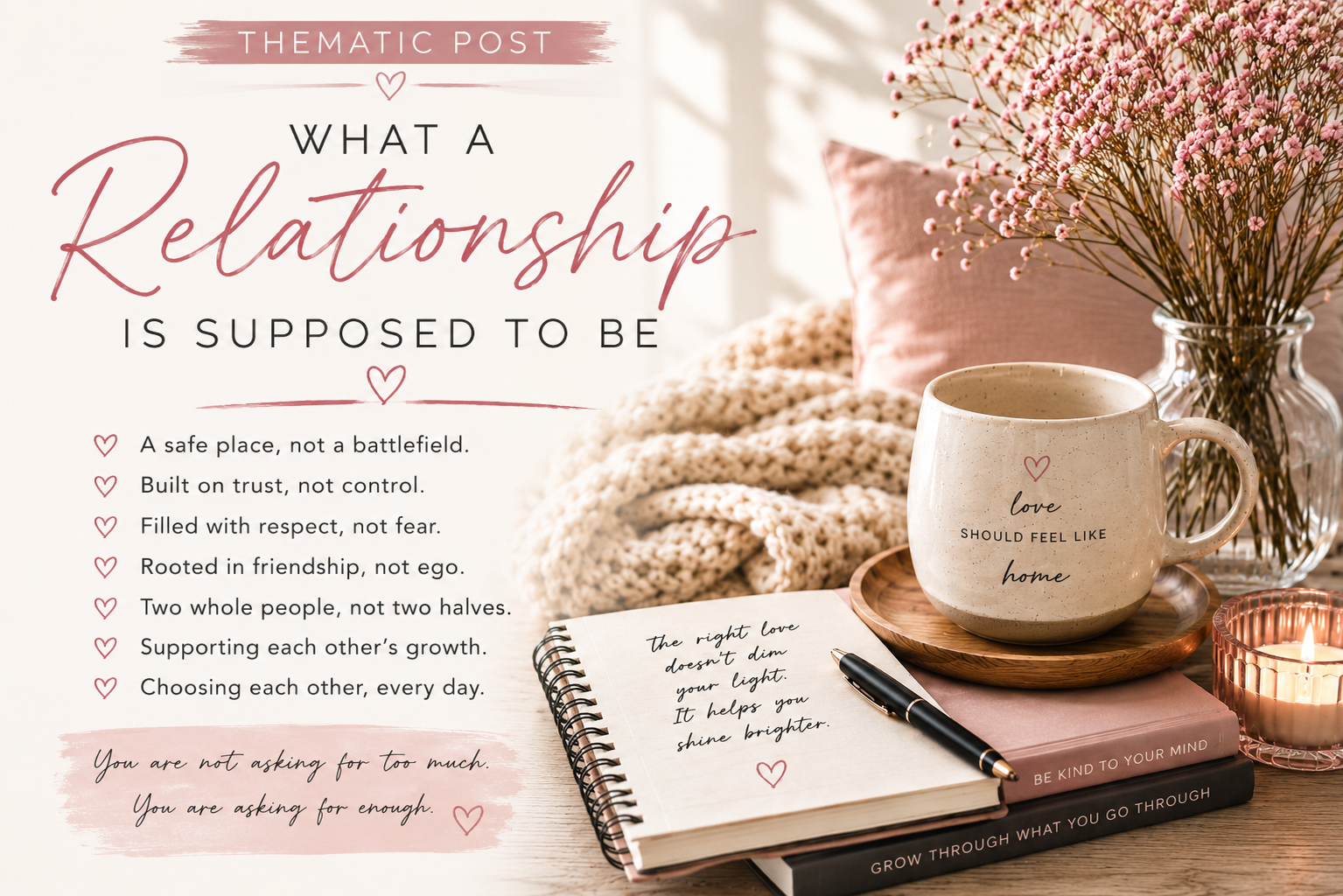
What a relationship is actually supposed to look like. What it is supposed to feel like. What the fundamentals are — the non-negotiables, the things that are not extras or bonuses or things to be grateful for when they occasionally appear — but the basic structure of what two people owe each other when they choose to build a life together. The vision we grow up with as young children of how our Happily Every After will look.
I lost sight of that baseline for a long time. Not because I did not know it intellectually. But because when you have been adapting to less for long enough, less starts to feel like enough. When you have been grateful for the good days for so long, you forget that good days were never supposed to be the exception. When your measure of whether things are okay is whether the worst has happened recently, you lose your sense of what okay actually looks like.
This post is about getting that sense back.
WHAT A RELATIONSHIP IS SUPPOSED TO REPRESENT
A relationship — a real one, a healthy one, the kind that is worth building and worth fighting for (the dream we had) — is supposed to be a safe place.
Not a perfect place. Not a conflict-free place. Not a place where difficult things do not happen or where two people never hurt each other or where everything is always easy and light and uncomplicated. Not all rainbows and unicorns. That version of a relationship does not exist and anyone selling it to you is lying.
But safe. Fundamentally, consistently, at its core — safe.
Safe means you can tell the truth and not be punished for it. Safe means your feelings are received rather than weaponised. Safe means that on the days when you are struggling there is someone in your corner rather than someone adding to the weight. Safe means you do not have to perform. You do not have to manage. You do not have to calculate how what you say or do or feel is going to land before you allow yourself to say or do or feel it.
Safe means you are chosen. Not once, at the beginning, when everything is easy and the future is shiny and there is no real cost to choosing. But in the ordinary moments. In the difficult ones. In the moments when choosing someone requires something real. You are supposed to feel — not all the time, not without doubt, but in the general ongoing texture of the relationship — that you are the person your partner is choosing.
The relationship’s that truly mirror that have taken love, respect and companionship, growth, evolution, compromise – from both sides for many years. But they did not just appear.
I did not always feel that.
WHERE OURS FAILED US
I want to be honest about this without turning it into an inventory of blame. Not because blame is not warranted in some areas — it is, and I have been clear about that elsewhere in this blog. But because the more useful question is not who failed who but where the relationship itself fell short of what it was supposed to be. And what we did with those failures. And what we were not able to do with them.
Ours failed us in safety. Not at first, but eventually. For long periods of time I did not feel safe. Not physically — I want to be clear about that — but emotionally. I could not tell the truth without bracing for the response. I could not need something without calculating whether the needing was going to cost me more than it was worth. I became so practiced at self-management in his presence that I sometimes lost track of what I actually felt because the feeling had been filtered through the question of whether it was safe to feel it.
Ours failed us in reciprocity. Again, not at first, but eventually. I gave and gave and gave. And he received and received and received. That is not a partnership. That is a caretaking arrangement. And for years I called it love, not because I did not know the difference, but because when the answers came and the answers were that he was an addict, the dynamic made sense. I know the difference now. I know now what it feels like to be a mother to your partner instead of a partner to your partner. This is a role that no one signs up for.
Ours failed us in accountability. Not at first, but eventually. When things went wrong — when the promises were broken and the cycles repeated and the damage accumulated — there was rarely a full and honest accounting of it. There was remorse, often genuine, and there were amends, often sincere in the moment, and there was the turning of a new page that felt real because he believed it was real when he said it. These periods went on for long spans of time. But the full reckoning — the sitting down and looking at the whole picture and saying I see what this has cost you and I take responsibility for that — that came rarely and incompletely towards the end, and always on his timeline rather than in proportion to what had been done.
Ours failed us in presence. Not always. And again, not in the beginning. There were seasons of genuine, full, extraordinary presence. But they were seasons. And in between the seasons there were stretches of absence — not physical, but the more insidious kind. The emotional absence. The being in the room without being in the room. The partner who was there and also somewhere else entirely. That particular loneliness — the loneliness of being with someone and still being alone — is one I came to know too well.
And ours failed us in the accumulation of it all.
Any single one of these failures might have been navigable. People survive imperfect relationships. People forgive and adapt and find ways through individual failures with grace and commitment and love. But all of them together, repeated, across years, each cycle leaving its mark — that accumulation does something to a person. It shifts your baseline. It recalibrates your sense of what is normal and what is acceptable. And by the time you step back and look at the full picture, you realise that what you have been calling your relationship barely resembles what a relationship is supposed to be.
HOW WE DEALT WITH IT
Imperfectly. I want to say that clearly because the honest answer is not heroic.
Over the years, I dealt with it by adapting. By lowering the bar, slowly, without consciously deciding to lower it. By finding ways to be okay with things that were not okay because the alternative — acknowledging that they were not okay and acting on that acknowledgement — felt too large and too costly and too uncertain.
I dealt with it through the program. Through learning to detach. Through asking how important is it and sometimes — not always, but sometimes — arriving at an answer that allowed me to release something that deserved to be addressed. I do not think that was always right. But it kept me functional in seasons where functional was all I could aim for.
I dealt with it through faith. Through handing things to God that I could not carry and trusting that the plan was larger than my understanding of it. That kept me from despair more times than I can count.
And I dealt with it, eventually, by telling the truth. To myself first. About what I was actually living in. About the gap between what I had and what I deserved. About the question I had been avoiding for years. I weighed up the pro’s and con’s of loving someone and knowing all their imperfections, vs leaving him and seeing what else the world had to offer.
THE QUESTION YOU HAVE TO ASK YOURSELF
Can I do another ten years of this.
Not should I. Not what does the program say. Not what would God have me do. In relation to the question of what would God have me do, you have to also understand what God expects for you from your partner. How you deserve nothing less than to he loved, honoured and adored. There is more on this later.
But honestly, looking at your actual life and your actual capacity and the actual cost of what you have already given — can you do this for another decade.
And if the answer is yes — is it yes because you genuinely believe things can and will be different? Or is it yes because you cannot imagine the alternative and the inability to imagine it has been disguising itself as hope?
There is no shame in either answer. I mean that without qualification.
There is no shame in saying yes. In choosing to stay. In deciding that the love is worth the cost and the person is worth the patience and the life you have built together is worth fighting for. That is a legitimate choice made by people with full agency and genuine love and I will never suggest otherwise.
And there is no shame in saying no. In reaching the point — however it arrives, however long it took to get there — where the honest answer to can I do another ten years of this is – I cannot. Where the accumulation has reached the limit of what you can carry without losing yourself entirely. Where love is still present but the capacity to keep paying the cost of it is not.
That is not failure. That is not weakness. That is not giving up on something worth saving. That is a person who has given everything she had and is finally, honestly, allowing herself to know when everything has become not enough.
WHAT YOU ARE NOT OKAY WITH
I want to give you permission to name this. Clearly. Without softening it.
What are you not okay with. Not in abstract terms — in specific ones. The specific things that have happened or keep happening that you have been absorbing as though absorption is the only option.
Name them. Write them down if you need to. Say them out loud to yourself or to someone you trust. Give them the weight they actually carry rather than the minimised version you have been carrying them in.
Because here is what I have learned about the things we are not okay with. The ones we never name – develop a particular kind of power over us. They sit in us and drive decisions and shape responses and accumulate into an architecture of resentment and depletion that we carry around like furniture we do not remember acquiring. Naming them does not solve them. But it restores them to their actual size. And their actual size is something you can work with. Naming them, listing them, visually recognising the inventory of things you are not okay with, gives you an honest perception of what you thought was a mole hill you could easily scale, was actually a mountain you were never willing to climb.
You are allowed to not be okay with things. You are allowed to have a list. You are allowed to look at that list and decide — honestly, not in the heat of the moment but in the clarity of genuine reflection — which items on it are things you can live with and which ones are not.
And you are allowed to conclude that there are things on that list that you cannot keep living with. Not without consequence. Not without cost. Not without it eventually taking something from you that cannot be replaced.
THERE IS NO SHAME IN SAYING THIS IS NOT FOR ME
I want to say this as clearly as I know how.
There is no shame in reaching the end of your capacity for this journey.
You are not a failure for having limits. You are not a bad partner for having reached them. You are not lacking in faith or love or resilience or any of the other things people suggest you are lacking when they cannot understand why you would leave.
Some journeys are simply not sustainable indefinitely. Some seasons of loving someone through addiction end not because the love ran out, but because the person doing the loving has reached the honest, clear-eyed limit of what they can give without destroying themselves in the giving.
Knowing that limit is not weakness. It is self-knowledge. And self-knowledge — the real kind, the kind earned through years of honest reflection rather than arriving ready-made — is one of the most valuable things you can possess.
You gave this everything you had.
You loved with everything you were.
And if you have arrived at a place where everything you had and everything you were is no longer enough to sustain the path you have been on — that is not something to be ashamed of.
That is just the truth.
And the truth, however hard it is to hold, is always worth telling.
Love, Sloane

I'd love to hear from you!