
I did not need years to see it. I saw it early — in the beginning, back when I was still just getting to know him, still navigating the dynamics within his family, still learning the shape of the world he came from. I did not have language for it yet. I did not call it a wound. But I saw it. I felt it in rooms before I understood what I was feeling. And I knew it was not “normal”.
I could not fully understand growing up the way Carter did. So I led with empathy and compassion — not pity, something different from pity — and I tried, hard, to love him unconditionally and to understand the root of what I was seeing. Every word, every action, I could find a way to justify. I could excuse it as upbringing, as learned behaviour, as something that had been done to him rather than something that was truly him. And I truly believed, for a very long time, that I could make a difference. That my love, applied consistently enough, patiently enough, could be the thing that finally proved to him he was safe.
The drugs. The women. The gambling. Those were the symptoms of the wound. The areas in which the wound expressed itself, let the world know there was a wound to begin with. What I saw early, in the family, in the way love moved through that house, explained the behaviours.
The wound was made in childhood. It started in the quiet architecture of a home where love arrived conditionally — where being seen, being praised, being wanted, was tied to what you did rather than who you were. I do not think anyone sat a small boy down and told him that directly. Nobody has to. Children learn these things by watching what gets rewarded and what gets overlooked. They learn, long before they have the language for it, what earns them a place in the room and what makes them invisible.
His dad was a complicated man. He loved Carter — deeply, genuinely, in ways that showed up in real and tangible moments. He paid rehab bills. He showed up in hospital rooms. He worried, in his final days, about whether Carter was going to be okay. That love was real. But it was expressed primarily through Carter’s performance. Through the sport. Through achievement. And when the achievement was gone, something in that expression of love became harder to find. Not because the love itself was gone — I do not believe that. But because he did not have the tools to find it in the ordinary moments. In the quiet ones. In the ones that do not require you to be exceptional at anything, or forgiven for anything, to still be loved.
His mom carried her own version of it. She had never fully healed from her own childhood — whatever had happened there, whatever had gone unaddressed, had simply been carried forward into her own adulthood, unresolved. And then a marriage of its own kind of difficulty added more weight on top of what she was already carrying. I do not think she set out to parent from that place. I do not think anyone does. But you cannot give a child what you have never been given yourself, and you cannot fully protect a child from wounds you have not yet tended to in your own life. Two parents, each carrying something unhealed, raising a boy in the middle of it — that is not a villain’s origin story. It is just how wounds move. Quietly. Without anyone meaning for it to happen.
Carter learned early that being exceptional was how he stayed seen. And then the ice gave him a place to be exceptional in a way that was undeniable. For years, that was enough of a band-aid. Not a healing — just a covering large enough to sit over the wound and hold it closed. Something to prove, a stage big enough, that the quieter and older question — am I enough without this — never had to be asked out loud.
And then the injury came. And there was no band-aid left big enough to cover what was underneath it. The recruiters stopped calling. The sponsors moved on. The fans disappeared, and with that, so did affirmation. And the wound that had been sitting there since long before he ever stepped onto the ice was torn open, wider than it had ever been opened before.
That is a particular kind of grief. The kind that does not announce itself. The kind that does not come with a funeral or a ceremony or anyone sitting with you while you feel it. It just tears open — and starts looking for somewhere else to go.
And it found somewhere else to go. It always does.
I do not think anyone said to him, at any point, that he was still worth something without it. Not clearly. Not in a way that landed. I tried. God knows how hard I tried, to show him, in so many ways, that he was enough. That he was loved – regardless of his achievements – or lack thereof. He was never in a mental space to truly hear, comprehend and accept the ways I tried to love him. And so what tore open that day became something far larger than a sporting injury. It became, once again and more loudly than ever, the loss of being enough. Of having a reason to be proud of himself. Of knowing where he fit in the world when the thing that had always told him where he fit was suddenly gone.
One of the most profound — and saddest — moments I ever had with Carter came years into our relationship, after a fight. He asked me, genuinely, why I still told him I loved him in the moments I was angry with him. He asked it as though my love were a switch, controlled by whatever I happened to be feeling in that hour. I remember having to explain it to him the way you might explain something to a child — that my love for him did not disappear when we argued. That it was not measured only on my good days with him. That it was my emotions that rode the wave, up and down, moment to moment — in a given hour I might not have liked him very much at all — but that my love for him underneath all of it was constant. It did not waver.
I could not fully comprehend the question when he first asked it. Not in my own family, not with any friend I have ever had, did I once question whether someone loved me simply because we were in the middle of a hard moment. That was never how love worked in the world I came from. But it was, seemingly, exactly how it had worked in his. Love that had to be re-earned after every rupture. Love that was not assumed to survive conflict, because in his experience, perhaps it never reliably had.
Years later, one of my own therapists said something that undid me a little, in the way that a true thing sometimes does. We were talking about Carter — about the cycles of our relationship and the way he seemed to self sabotage things whenever they were going well between us, how the better things got, the more likely he was to find some way to break them. She said that for someone raised the way Carter was, family does not read as safe. Read that again – for him, family is not SAFE. That moment, right there, was the lightbulb. That took years of knowing what the cycle was, knowing that self sabotage was just a thing that he had embedded into our relationship over more than a decade, but it was the why I could never comprehend. And that moment right there was the last piece of a puzzle I had been trying to complete for years. That when his own family — the one he had actually built, the one that was, by any honest measure, doing well — was thriving, some part of him did not believe it would last. Could not believe it would last. And so he found ways to destroy it himself, before it had the chance to destroy him first – all because family was not safe .
I sat with that for a long time. Because it explained so much more than the affairs, more than the disappearing whenever things were good. It explained the fear underneath all of it — the need to control the ending of every story that ever threatened to be genuinely, lastingly good. If you are the one who breaks it, at least you saw it coming. At least it was not done to you the way it must have felt, once, a very long time ago.
I say all of this not to excuse what came after. I have never confused understanding with excusing — they are not the same thing and they never will be. I say it because I think it is important to look at the full picture of the person you love. Not just what they are doing now, in this season, in the ways that are hurting you — but what made them. What broke them before you even knew them. What wound they have been trying to cover ever since, with whatever tool they could find, in whatever way was available to them.
Generational wounds work like this. They do not announce themselves. They pass from one person to the next without anyone meaning for it to happen. Two parents who did not know how to offer love in the quiet moments raised a son who learned, from somewhere near the very beginning, that he had to earn the loud ones — and who grew into a man who genuinely did not know that love could survive an argument, and who could not trust that a good and thriving family was allowed to simply stay good and thriving. A man who cannot sit with himself in the quiet, who does not trust love to hold through conflict or through calm, will always be looking for the next thing that makes the uncertainty bearable. Or he will simply end the story himself, on his own terms, before it can end the way he has always secretly believed it must.
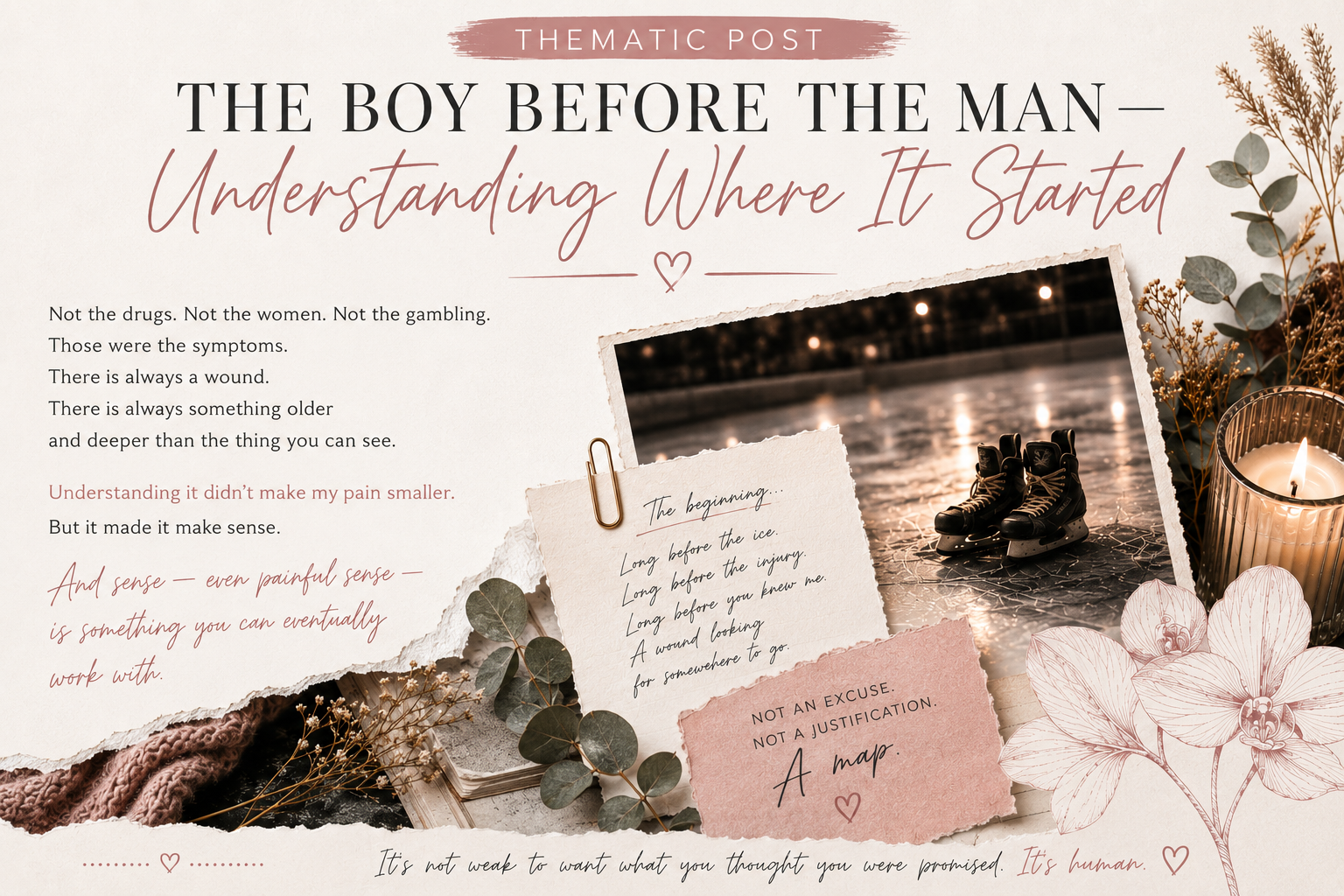
That is not a justification. It is a map.
And maps matter. Not because they excuse the journey, but because they help you understand it. They help you see that the person who hurt you was also, somewhere long before you arrived, a child who was hurt. That the behaviour which devastated you was not born on a rink at seventeen. That there is a root beneath it, buried much earlier and much deeper, that has nothing to do with you and everything to do with something that was set in motion in the years before either of you could have known what it would grow into.
Understanding that did not make my pain smaller. But it made it make sense. And sense — even painful sense — is something you can eventually work with.
If you are in a relationship with someone whose behaviour confuses you, whose cycles exhaust you, whose moments of brilliance make the darkness so much harder to understand — ask yourself what you know about the boy or girl before the person standing in front of you. Not just the visible turning point. Go earlier than that. Ask what they learned, long before anyone could see it, about what it took to be loved. Ask what they lost — quietly, invisibly, long before the loss anyone else noticed — before you ever had the chance to help them find it. And ask yourself, honestly, whether the thing that looks like self-destruction might actually be something closer to self-protection — a person ending the story on their own terms because some part of them never believed they would be allowed to keep it.
You do not have to fix it. That was never your job and it never will be. But understanding it might give you the compassion to stop taking it personally. And that compassion — for them and for yourself — might be exactly what you need to find your own way through.

I'd love to hear from you!