
Let me say that again, clearly:
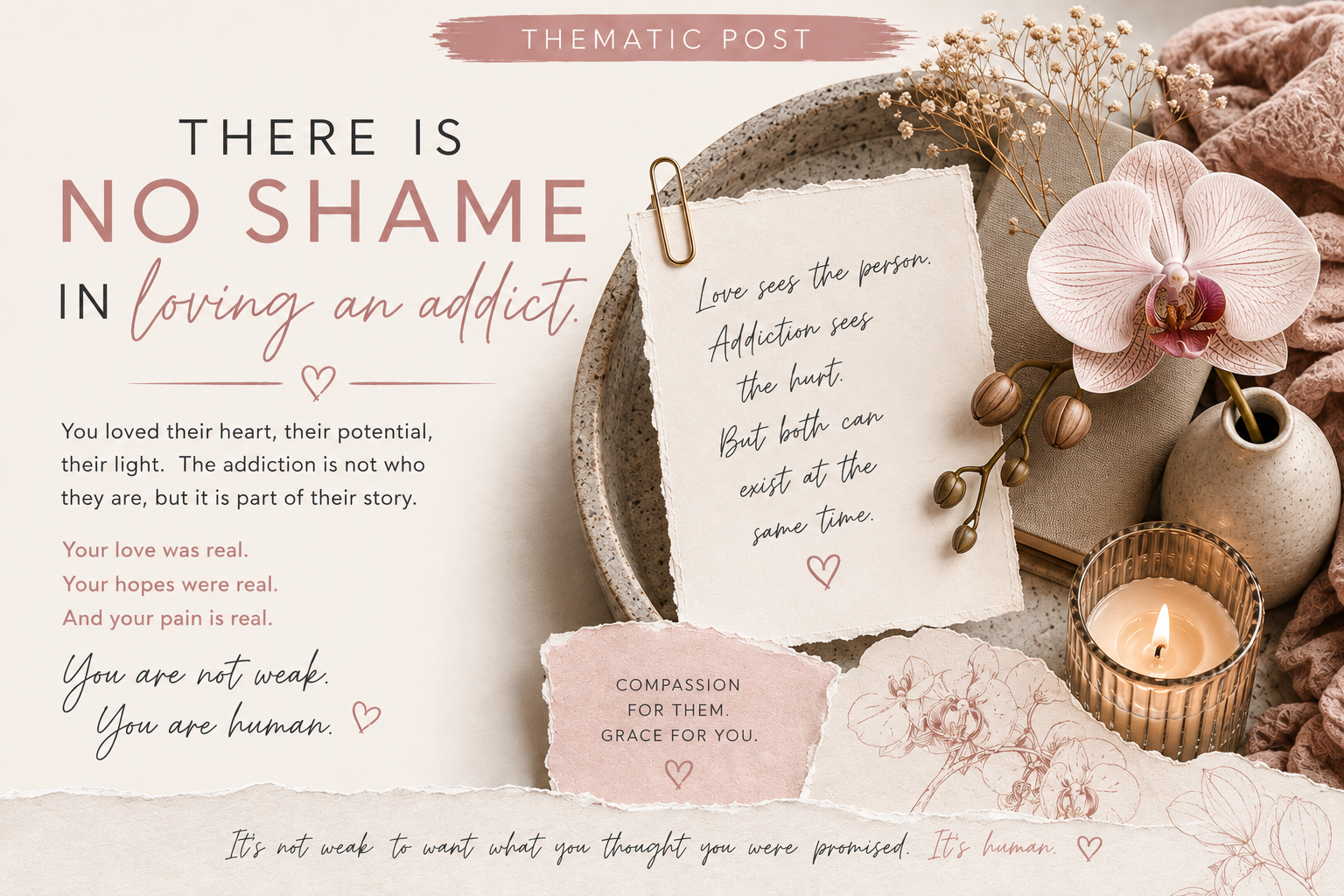
There is no shame in loving an addict.
Not in staying. Not in leaving. Not in going back. Not in the years you gave. Not in the hope you kept alive long past the point where anyone else would have let it go. Not in the love itself — which was real, which was whole, which was given freely and fully and without condition.
None of it is something to be ashamed of.
I want to say this at the very beginning of this blog because I know that somewhere out there someone is reading these words and feeling exactly what I felt for so many years — a quiet, persistent, grinding shame. Shame that you stayed. Shame that you loved someone who hurt you. Shame that you could not fix it. Shame that you are still not over it. Shame that part of you still loves them even now.
That shame does not belong to you. It was never yours to carry.
WHERE THE SHAME COMES FROM
The shame comes from the outside. From the people who looked at your situation and could not understand why you did not simply leave. From the friends who disappeared because they could not watch what was happening to you. Who gave you so much (unsolicited) advise, but when finding themselves in similar situations come to realise its never as easy as it seems. From the family members who loved you and expressed that love as frustration — why do you keep going back, why do you keep forgiving him, why can you not see what we can see.
They were not wrong to be concerned. They loved you. They were watching someone they cared about being hurt over and over again and they did not have the framework to understand why you stayed. Most people do not have that framework unless they have lived it. And unless you have lived it — unless you have loved someone through addiction, felt the pull of who they are in their best moments, understood that the person doing the damage and the person you fell in love with inhabit the same body — you cannot fully understand the choice to stay.
The shame also comes from a world that has a very specific picture of what a strong woman looks like. She does not stay. She walks away with her head held high. She does not look back. She does not forgive the same thing seventeen times. She does not love someone who steals from her or lies to her or chooses a substance or a habit or another woman over her again and again.
That picture is incomplete. And it has caused an enormous amount of unnecessary suffering to an enormous number of people who loved well and faithfully and were made to feel that their love was a weakness rather than a strength.
WHAT LOVING AN ADDICT ACTUALLY REQUIRES
I want to tell you what it actually takes to love an addict. Not what it looks like from the outside. What it actually requires from the inside.
It requires a capacity for compassion that most people will never be tested on. The ability to separate a person from their illness. To see the human being underneath the destruction and choose to love that human being even when the illness is making them almost impossible to love.
It requires a resilience that is genuinely extraordinary. To get up after being knocked down — not once, not twice, but again and again — and still find the will to try again. To still believe in someone’s capacity for change even when the evidence is not cooperating – even when they do not believe in themself.
It requires a faith that goes beyond what is visible. Whether that faith is in God, in the universe, in the person themselves, in the possibility of recovery — it takes something to hold onto hope in the dark. That is not weakness. That is one of the rarest and most difficult things a human being can do.
It requires a love that is not transactional. A love that does not keep score. A love that gives without guarantee of return. That kind of love is not naive. It is not codependent. It is not pathological. It is actually one of the highest expressions of what love can be — and it is more than most people will ever be capable of.
None of that is shameful. All of that is extraordinary.
THE THING NOBODY TELLS YOU
Nobody tells you that loving an addict will change you in ways that are not all bad.
It will break you open in places you did not know were closed. It will teach you a compassion for human suffering that you could not have learned any other way. It will show you what you are made of — and what you are made of, it turns out, is considerably more than you knew.
It will teach you to read people. To sense shifts in energy before they become visible. To trust your gut in a way that most people never develop because they have never needed to. It will teach you to find stillness in chaos. To pray in ways that are not performative but desperate and real and deeply personal. To find God or faith or whatever you believe in not in the easy moments but in the unbearable ones.
It will show you who your real friends are. Who shows up when things are ugly. Who stays not because your life is entertaining but because they love you enough to sit in the hard parts with you.
And it will show you — eventually, when you are ready to see it — exactly how strong you are. Not the performative strength of someone who never falls. The real strength of someone who falls and gets up and falls and gets up and keeps going anyway. That kind of strength is forged. It cannot be purchased or borrowed or inherited. It has to be lived.
You lived it.
It is important for me to say, that you also do not have to stay. Leaving is not weakness. Recognising the point that you are no longer safe (mentally, emotionally, physically), and taking action, that is also strength. Each person who travels alongside an addict in this journey has thresholds and cut off points. Whether yours is from the first lie, or after the thousandth, that is your journey, and yours alone. No one has the right to judge you for the how, why, what, where and when. The only thing that matters is how much (more) you can take before you toss the gloves aside and decide – today I am done. For some, that day may never come, and there may be a simple reason for that, or an intrinsic one. Either way, it is your journey.
THE MEETINGS THAT SHOWED ME I WAS NOT ALONE
I want to tell you about the moment I stopped being ashamed.
I used to accompany Carter to his AA and NA meetings in the beginning. When the introductions would go around the room, I would say, Hi, I am Sloane, I am here to support. I then ended up being invited to join the meetings for the spouses of the addict.
My shame did not disappear all at once. It happened in a room. A room full of strangers who were not strangers for very long. A room where people said things out loud that I had only ever said inside my own head. A room where nobody looked at me with pity or confusion or the expression of someone trying to figure out why I had not simply left.
In that room I heard my experience reflected back to me for the first time. I heard women — and men — describe the specific texture of what I had been living through in words that matched my own internal experience so precisely that I felt, for the first time in a very long time, that I was not crazy. That I was not weak. That I was not alone.
I sat in the back the first time and I did not speak. I just listened. And I cried. Not from sadness — or not only from sadness. From relief. The particular relief of being seen by people who truly understood what they were seeing. All were in different stages of recovery, some who’s partners have just found their sobriety, some who’s partners had decades of recovery, some who’s partners had long passed but still continue to give to the community and give back to those who are new.
That room gave me back something I had not realised I had lost. The knowledge that what I had done — the loving, the staying, the hoping, the getting back up — was not shameful. It was human. It was, in its own complicated and painful way, brave.
You deserve to feel that too.
If you have not found your room yet — go find it.
It is waiting for you.
TO THE PERSON CARRYING THE SHAME
If you are reading this and you are carrying shame — about staying, about loving him, about the years you gave, the “wasted time”, about the person you became in the process of surviving it — I want you to put it down.
Not because what happened was okay. Not because the hurt does not matter. Not because you should not have boundaries or standards or a point at which you say enough.
But because shame is a weight that serves no one. It does not undo what happened. It does not protect you going forward. It does not make you wiser or stronger or safer. It just sits on you and makes everything heavier than it needs to be.
You loved someone. Deeply, faithfully, with everything you had. That is not something to be ashamed of. That is something to be — when you are ready, when the dust has settled, when the weight of it has become something you can look at clearly — quietly, privately, genuinely proud of.
Because not everyone could have done what you did.
And not everyone would have.
There is no shame in loving an addict.
There is only the truth of what it cost you and what it made you and the long, slow, piece by piece work of finding yourself on the other side of it.
That work starts here.
And you are already doing it.

I'd love to hear from you!