
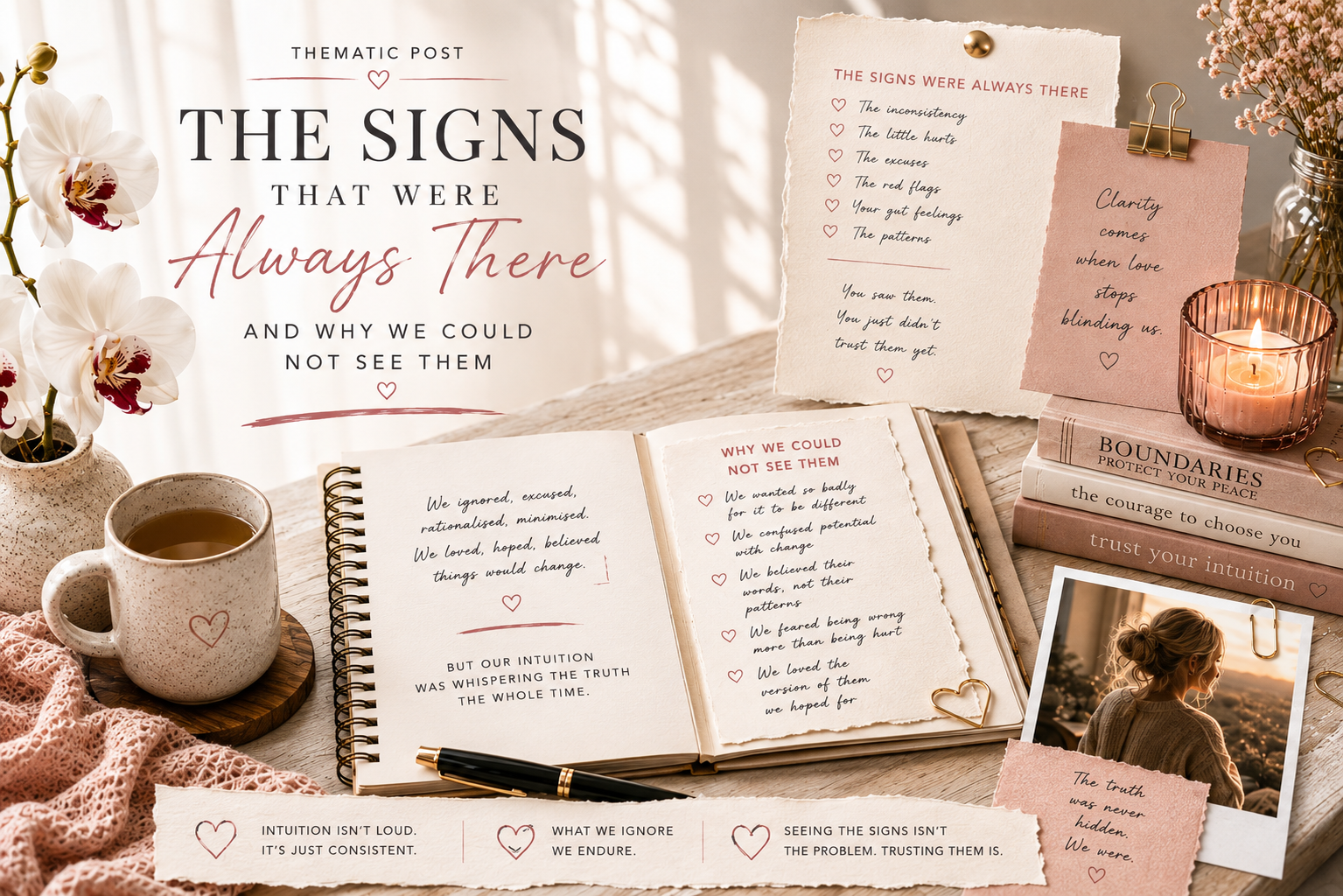
Hindsight is an extraordinary thing.
Looking back across more than two decades I can see the signs so clearly that it is almost difficult to understand how I did not see them at the time. The pattern was there from the beginning — not fully formed, not presenting itself with the clarity it eventually would, but there. A consistent thread running through the earliest days that I did not have the language to identify and that the love I was already feeling made me disinclined to look at too carefully.
That is the thing about red flags in the early stages of a relationship. They are almost never the dramatic, unmistakable warnings that they become in retrospect. They arrive subtly. They are easy to explain away, to justify. They sit alongside enough charm and warmth and genuine connection that the mind — which wants so badly to believe in the good things it is experiencing — finds explanations for them that allow the good things to continue.
This post is not about blame. Not for you for missing them and not for him for showing them. It is about understanding — why the signs that seem so obvious in retrospect are so genuinely difficult to see in the moment and what you would have had to lose if you had seen them and acted on them early.
Because here is the question nobody asks about red flags. Even if you had seen them clearly — even if some older, wiser version of you had sat down beside you in those early days and said look, here is what this is and here is where it is going — what would you have chosen to do with that information.
I think about that question a great deal.
WHY WE DO NOT SEE THEM
We do not see them because we are not looking for them. In the early days of falling in love the brain is flooded with chemicals that are specifically designed to make everything about the other person seem wonderful and everything concerning seem unimportant. This is not weakness. This is biology. The same neurological processes that drive the early intensity of romantic love also suppress the critical thinking that would allow you to evaluate what you are experiencing more objectively.
We do not see them because they do not look like what we have been told red flags look like. The popular image of a red flag is dramatic — the person who is immediately controlling or aggressive or dishonest in obvious ways. But the kind of red flags that accompany the early stages of addiction and the early stages of love addiction in particular are subtle. They look like intensity. Like a passionate person. Like someone who loves big and feels deeply and whose emotional world is more vivid than anyone you have met before. Those things are exciting. They do not read as warnings.
We do not see them because we do not yet know this person well enough to identify what is a pattern and what is an isolated incident. A pattern requires time to establish itself. In the early months of a relationship you have individual data points — this happened once, that happened twice — without enough of them to connect into the picture they will eventually form.
We do not see them because the good things are so genuinely good. The person showing you the red flags is often also showing you something extraordinary. The warmth, the laughter, the way they look at you, the specific aliveness of being with them. The red flags do not arrive in isolation. They arrive alongside the very best version of the person — the version that is capable of great love and great generosity and the particular magic of making you feel like the most important person in the room. And the mind is not well designed for holding warning and wonder simultaneously. It tends to choose one.
And we do not see them because seeing them clearly would require us to act on them. And acting on them would mean walking away from everything we are already feeling. That cost — in the early days when the feeling is new and overwhelming and the future is still all possibility — is one that most people are not yet equipped to pay.
Throw being young into that equation, along with the lack of lived experience, is just one big recipe for disaster.
WHAT THE SIGNS ACTUALLY LOOKED LIKE
I want to be specific here because I think specificity is more useful than generality.
The intensity that felt like passion. The way he pursued me completely, overwhelmingly, with a focus and an energy that felt like being chosen by someone extraordinary. What I did not yet know was that intensity of pursuit in the early stages of a relationship is sometimes a sign of health and sometimes a sign of something else entirely. The kind of intensity that cannot tolerate distance, that needs constant contact and constant reassurance, that escalates very quickly to declarations of depth and commitment — that intensity can be love addiction announcing itself before you have the vocabulary to name it.
The charm that worked on everyone. He could walk into any room and own it. Everyone loved him. That quality felt magnetic in the beginning — I was with someone that everyone wanted to be around. What I did not yet understand was that the same need for external validation that made him the life of every party also meant he was always, on some level, seeking the next source of it. The charm was real. But it was also — I came to understand — compulsive in a way that had nothing to do with me and everything to do with a wound that needed constant tending. This too though is a very difficult reference to make, because I can also say that there was undoubtedly a lot of real love between us, despite his actions. I will jump into more detail on this in a later post.
The first instance of something I explained away. There is always one. A moment early on that I registered and then immediately found a reason for that had nothing to do with what it actually was. Something I filed under he was stressed or that was a one-off or everyone does that occasionally. Looking back I know exactly what that moment was. I knew then too, somewhere beneath the explaining away. I just was not ready to know it yet.
The relationship with his mother. I write about this in its own section of this blog so I will not go into full detail here but the family of origin patterns were visible early if I had known what I was looking for. The wound that drives addictive / abusive behaviour is almost always formed in childhood and it leaves traces in the way a person relates to their family, to authority, to love, to conflict. Those traces were there. I mistook them for complexity rather than seeing them as information. I made excuses for them.
And the small moments of dishonesty. Not big lies — those come later, when the addiction is further established and the stakes are higher. Small ones. The slightly amended version of a story. The explanation that did not quite add up but that I chose not to press because pressing felt more disruptive than accepting. The feeling of something being not quite right that I talked myself out of because I did not yet trust that feeling more than I trusted him.
WHAT YOU WOULD HAVE LOST
This is the question I want to spend some time with because I think it is the one that goes unasked.
If you had seen the red flags clearly and acted on them early — what would you have lost.
In my case. I would have lost Carter. The relationship. The 24 years. Everything I have written about in this blog — the good and the bad together.
I would have lost Alexia. I would have lost Gabriel. I would have lost the specific extraordinary human beings that exist in the world because of the specific choices I made to stay and to try and to keep choosing him.
I would have lost the joy in Alexia’s and Gabriels’s eyes whenever Carter walked in the door, the joy on both their faces when daddy was home.
I would have lost the version of myself that was forged in the fire of all of it. The depth of understanding I have of human nature and human suffering. The faith that was built not in easy seasons but in impossible ones. The particular strength that only comes from being tested beyond what you thought you could survive and discovering you were wrong about your limits.
I would have lost the story I am telling right now. Which has the potential to reach someone somewhere who needs to know they are not alone and that there is a way through.
None of that means the red flags were not real or that ignoring them was wisdom rather than a very human and understandable choice. It means that life is rarely clean enough to be reduced to – I should have left earlier. The losses of leaving earlier would have been as real as the losses of staying. Just different losses. Just a different story.
WHAT TO DO WITH THIS NOW
If you are reading this from the beginning of your journey — from a place where the relationship is still active and the red flags you are now recognising are things you are still in the middle of — this post is for you in a specific way.
You are not stupid for not seeing them earlier. You are not weak for explaining them away. You are a human being who loved someone and who — like every human being who has ever loved someone — was equipped with the full and complicated set of human capacities for both seeing clearly and choosing not to for very understandable reasons.
What you can do now is see clearly. Take what this post has named and apply it honestly to your own situation. Not to punish yourself for what you missed. To understand what you are working with. To stop explaining things away and start letting them be what they are.
And if you are reading this from the other side — from a place where the relationship is over and you are processing how you got here — this post is for you in a different way. Permission to stop asking yourself why you did not see it sooner. You saw it exactly as soon as you were ready to. And the path that brought you here, red flags and all, brought you everything that path brought you. Including this. Including now. Including the person you have become in the living of it.
That person is worth what it cost to become her.
Even the parts that were hard to see coming.
Love, Sloane

I'd love to hear from you!